Are You Unknowingly Destroying Your Collectibles' Future Value? The Hidden Risks of Common Storage Mistakes
Collectible storage risks rarely announce themselves with a dramatic accident. More often, a prized comic develops a faint yellow cast, a trading card acquires a surface impression, a signed print fades gradually, or a sealed figure becomes sticky inside its original packaging. By the time these changes are visible, the damage may already be difficult or impossible to reverse.
For collectors who view their collections as both personal treasures and long-term assets, the distinction between owning a rare object and preserving its condition matters. Rarity may help establish desirability, but condition, originality, completeness, authenticity, and documented provenance can all influence how an item is evaluated. Storage cannot guarantee future market value, yet avoidable deterioration can undermine the qualities that make a collectible desirable in the first place.
The central question is not whether an item needs an expensive enclosure. It is whether the environment and materials surrounding it are chemically and physically compatible with what it is made of. Paper, coated cardboard, photographic emulsions, metals, textiles, vinyl, and modern synthetic plastics respond differently to the same conditions. A sensible preservation strategy begins by comparing those risks instead of applying one universal storage rule.
1. The first comparison: Which storage risks matter most?
Storage decisions are easier to understand when each threat is connected to a mechanism of damage. Light can initiate fading; moisture can encourage mold and dimensional change; heat can accelerate chemical reactions; unstable packaging can transfer acids or additives; and pressure can leave permanent deformation. Dust, pests, pollutants, and careless handling add further risks.
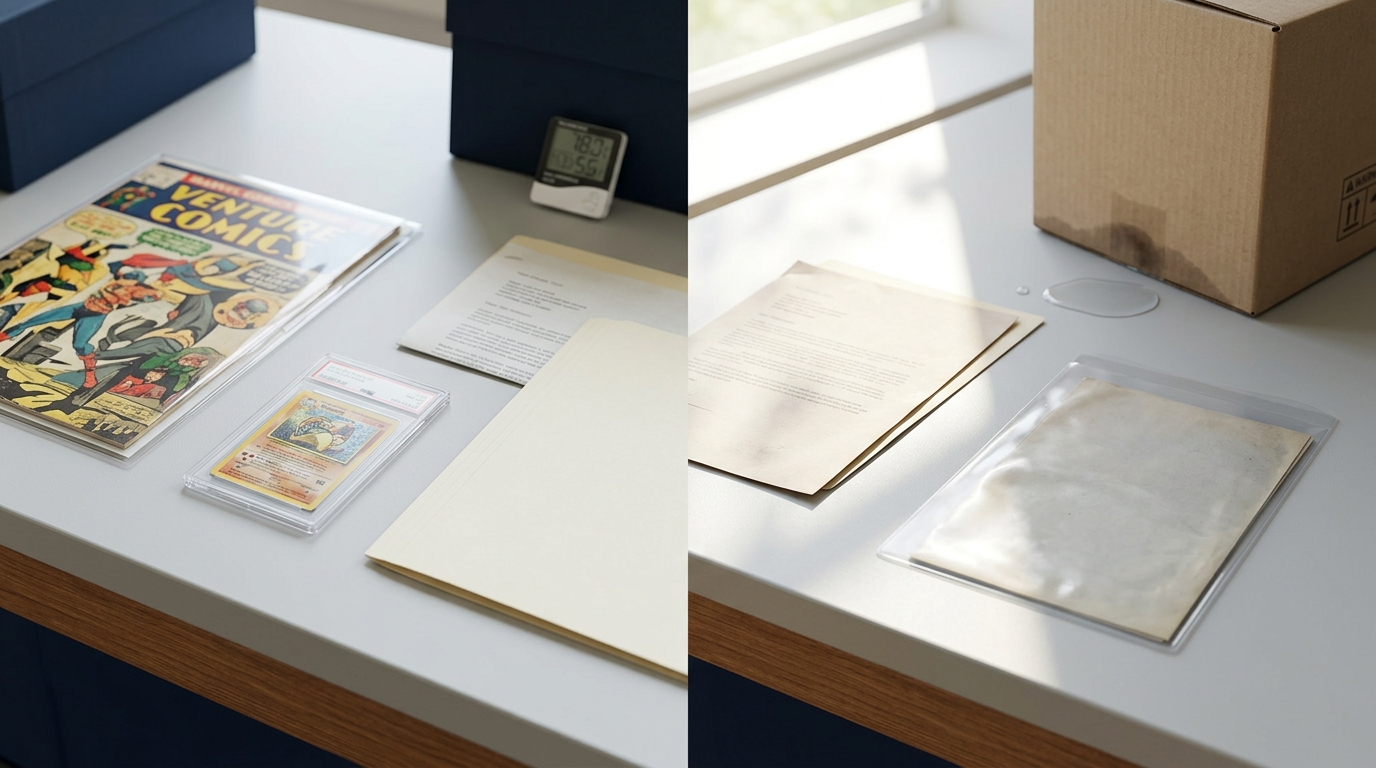
These threats are not interchangeable. A sealed trading card kept away from sunlight may still be exposed to damaging pressure, while a paper print stored in a chemically stable folder can still deteriorate in a damp basement. Preventive storage works best when it addresses the dominant risks for a specific object and its location.
Consider three common approaches. Open shelving makes inspection easy but offers limited protection from dust, light, and accidental contact. A closed cabinet reduces some exposure but may trap moisture or pollutants if its environment is poorly managed. Individual protective housings can reduce abrasion and handling damage, although an inappropriate sleeve can introduce a new chemical or surface-contact problem. No option is automatically best in every circumstance.
Five criteria for evaluating a storage arrangement
- Environmental stability: Does the location avoid repeated temperature and relative-humidity changes?
- Light management: Can sunlight and unnecessary display illumination be reduced?
- Material compatibility: Are the sleeve, folder, box, adhesive, and nearby materials appropriate for the collectible?
- Physical support: Can the object bend, slide, rub, become compressed, or fall?
- Inspection and access: Can the collector check its condition without repeatedly handling or disturbing it?
If an item is frequently displayed, light management and a safe viewing arrangement deserve particular attention. If it is rarely handled, stable environmental conditions and suitable long-term housing may be more important. If the collectible contains several materials, such as a signed photograph mounted on acidic board, the most vulnerable component should help determine the storage method.
2. Comparison table: Common mistakes versus preservation-minded alternatives
The following comparison connects everyday habits to the damage they can cause and the reasoning behind a more protective alternative. These are general principles, not universal environmental specifications for every collectible.
3. Humidity and temperature: The damage that develops out of sight
Relative humidity describes how much water vapor is in the air compared with the amount that air could hold at the same temperature. It affects the moisture content and behavior of many collection materials. Paper can expand and contract as conditions change, coatings can become more vulnerable, metal corrosion can accelerate in damp environments, and some materials become more susceptible to biological growth.
High humidity is not simply an aesthetic problem. The Library of Congress explains that photographic gelatin binders can soften and become sticky under humid conditions, while low humidity can contribute to shrinking, cracking, and curling. Mold can also damage collection materials, and once it becomes established, cleaning may be difficult without causing additional harm. These mechanisms help explain why an item can appear normal for months before its storage conditions produce noticeable changes.
Temperature matters independently and in combination with moisture. Higher temperatures generally accelerate many chemical deterioration processes. For certain photographs and unstable film bases, cool or cold storage can substantially improve longevity, but those requirements should not be applied indiscriminately to unrelated collectibles.
For many household collections, the practical starting point is a dry, stable, clean room rather than an attic, basement, garage, or location beside a radiator, exterior wall, or air-conditioning outlet. A digital hygrometer can provide a useful snapshot of relative humidity. A temperature-and-humidity data logger is more informative when the concern is a recurring overnight swing, seasonal dampness, or a room that becomes humid when heating or cooling changes.
For example, a reading taken on a comfortable afternoon does not prove that a cabinet stays stable through a rainy week. If readings repeatedly rise after rainfall, investigate the room, ventilation, leaks, and nearby exterior walls before simply adding desiccant. Moisture absorbers can have limited capacity, require maintenance, and fail to address the underlying cause.
Why a single ideal humidity number can mislead
There is no single relative-humidity target that is optimal for every collectible. Paper, photographs, metals, textiles, wooden objects, and certain plastics have different needs. Even two paper-based objects may require different treatment because one contains friable pastel and the other is an ordinary printed document.
The Library of Congress recommends approximately 35% relative humidity for works on paper in its general storage guidance, while its photograph guidance describes a different range for photographic materials. These are collection-specific recommendations, not a reason to force an entire mixed collection to one setting without considering material compatibility.
If the collection contains highly valuable photographs, unstable film, active corrosion, or objects showing mold, professional conservation advice is more appropriate than experimenting with abrupt temperature or humidity changes. Avoid moving cold-stored objects directly into warm, humid air without understanding condensation risks and the required acclimatization process.
4. Light and UV exposure: Why a bright room can be an expensive mistake
Sunlight contains ultraviolet radiation, visible light, and infrared energy. These components can contribute to different forms of damage, including fading, discoloration, and heating. Light-sensitive dyes and pigments may change even when the exposure is not intense enough to look alarming to the eye. Damage is cumulative: reducing the duration of exposure is therefore important even when a display does not receive direct sunshine.
UV-filtering window film can reduce ultraviolet transmission through a suitable window, and UV-filtering glazing can serve a similar role in a display. However, these interventions should not be confused with complete protection. They do not necessarily prevent visible-light fading, eliminate heat buildup, or compensate for an object displayed continuously under strong illumination.
The better approach combines several measures: position sensitive objects away from windows, use blinds or opaque covers when displays are not being viewed, limit display duration, and avoid placing enclosed objects under heat-producing lighting. A UV-filtering window film is one part of this strategy, not permission to leave a rare print or card in bright light indefinitely.
This trade-off matters particularly for signed paper collectibles, vintage posters, original comic art, and color photographs. Their appearance may be central to their desirability, and fading can be irreversible. If an object is valued primarily for display, a high-quality reproduction can sometimes provide the visible experience while the original remains protected. This is not appropriate for every collection: where the original itself is intended to be exhibited, carefully controlled exposure may be preferable to permanent concealment.
Collectors should also remember that light protection and UV protection are not synonyms. A dark enclosure can protect an item from light while it is stored, whereas a UV filter primarily reduces one part of the radiation reaching it. Both the total exposure and the sensitivity of the materials matter.
5. Archival plastics, paper, and adhesives: When protection becomes the problem
The word "archival" is not a universal guarantee. Products described as archival or acid-free may still differ in composition, additives, surface treatment, buffering, and suitability for a particular object. An enclosure can look clear and clean yet be chemically inappropriate for the material inside it.
The Library of Congress warns against using polyvinyl chloride (PVC) enclosures for photographs and identifies suitable options that include uncoated polyester, polyethylene, and polypropylene in appropriate applications. That guidance should not be interpreted as proof that every product made from these polymers is safe for every collectible. Coatings, plasticizers, manufacturing residues, and the object's own surface characteristics still matter.
For example, a polypropylene card sleeve may be appropriate for a frequently viewed trading card if its construction and fit are suitable. But a brittle historical photograph, a tacky plastic surface, or an object already showing chemical deterioration requires a more careful assessment. The fact that a sleeve is transparent says nothing reliable about its chemical stability.
Paper-based housing has its own trade-offs. Acid-free document boxes can reduce exposure to poor-quality acidic materials and offer physical protection, but buffering is not automatically appropriate for every medium. Some photographic processes, colorants, and other sensitive materials require unbuffered housing. The exact contents matter more than a generic label.
Unbuffered archival tissue may help separate or cushion compatible objects, but it is not a universal interleaving material. Likewise, polyester film sleeves offer visibility and support for certain paper items, yet static charge can lift friable media such as pastel, charcoal, or flaking paint. An enclosure that improves handling for one object may increase the risk to another.
Adhesives deserve similar caution. Ordinary tape, rubber bands, self-adhesive album pages, and glue can stain, leave residues, cause embrittlement, or damage surfaces. Do not apply adhesive directly to an original collectible simply to keep it flat or secure a label. Place identification information on the housing whenever practical, and avoid writing on delicate or valuable objects without an established conservation reason.
For photographs in particular, consult the Library of Congress photograph-preservation guidance before selecting a sleeve or box. Its recommendations distinguish among enclosure materials, humidity conditions, and different photographic processes. For paper-based collectibles, the Library of Congress guidance on works on paper explains the value of protective folders and boxes, as well as exceptions involving sensitive media.
6. Which storage approach fits which collector?
There is a meaningful difference between a collection that is handled every week and one that remains in long-term storage. The right choice depends on the object's material, frequency of access, condition, environment, and the consequences of an accidental mistake.
Frequently handled trading cards and modern collectibles
If an item is regularly inspected, photographed, or shown to other people, prioritize a suitable individual enclosure, a clean handling area, and a storage arrangement that prevents friction and pressure. A rigid holder can reduce bending, but the holder must fit correctly and be kept away from heavy objects. A card should never be forced into a holder that risks catching its corners.
Polypropylene card sleeves may be useful when their material and construction are appropriate. Still, an individual sleeve does not eliminate risks from heat, light, dirty hands, or a poorly designed storage box. If access is infrequent and the item is particularly fragile, a protective enclosure that minimizes handling may matter more than visibility.
Comics, magazines, and paper ephemera
If the object is primarily paper, focus on stable environmental conditions, protection from light, adequate support, and chemically appropriate housing. Acid-free document boxes and compatible folders can help reduce exposure to dust and poor-quality surrounding materials. Store items so that they do not slump, bend, or become tightly compressed.
Buffered paper products are often useful for appropriate paper collections, but not all printed media should be treated alike. Coated paper, photographs, unusual inks, and friable illustrations may call for different enclosures. If an old comic is already brittle or has detached pages, a conservator's assessment is safer than attempting to flatten, tape, or rebind it at home.
Signed prints, photographs, and light-sensitive artwork
If color stability and surface condition are central to the object's importance, prioritize low light exposure, suitable enclosures, and controlled environmental conditions. UV filtering can be useful in a display setting, but reducing display time is often more robust than relying on a filter alone. Keep the signature, image, and paper support in mind as separate components: a treatment safe for the paper may not be safe for the ink.
Photographs also require process-specific care. A print with a fragile emulsion, a historical negative, and a modern photographic print are not interchangeable. When the process or condition is unknown, avoid placing the item against an unfamiliar plastic surface or storing it in an uncontrolled humid environment until its needs are better understood.
Mixed collections and items of uncertain composition
If a cabinet contains paper, metal, vinyl, fabric, and plastic objects together, do not assume that one enclosure and one climate setting will serve them all. Separate objects that could abrade one another, transfer residues, or release deterioration products. Keep materials with active mold or unusual chemical odors apart from healthy objects while seeking appropriate professional advice.
When the material is unknown, conservative handling is preferable to an irreversible intervention. Photograph the item in place, record its condition, and seek specialist identification before cleaning, applying a coating, removing a label, or changing a historic mounting. Preservation sometimes means leaving a fragile object undisturbed until a suitable treatment is understood.
7. Warning signs, inspection routines, and the limits of home preservation
Routine inspection is useful because many forms of deterioration progress gradually. Look for changes in color, odor, surface texture, gloss, adhesion, warping, corrosion, or the fit of a holder. Check whether cardboard has become brittle, a plastic sleeve has turned tacky, a paper edge is curling, or a display cabinet repeatedly develops condensation.
Inspection should be documented rather than based entirely on memory. A dated photograph taken under similar lighting can help distinguish a real change from a difference in viewing conditions. Record the item's location, observed condition, and any significant environmental event, such as a leak, unusually humid spell, or nearby renovation.
There are limits to what household storage can solve. Environmental monitoring does not identify every chemical hazard; a UV filter does not stop all light damage; and an acid-free box cannot reverse existing embrittlement. Some collectibles contain unstable materials by design or by age, while others have already undergone damage before entering the collection. The goal is to slow preventable deterioration, not promise permanence.
Professional advice is especially valuable when a collectible is rare, highly valuable, structurally fragile, historically significant, or difficult to replace. Conservation specialists can help identify materials, distinguish active damage from stable aging, and determine whether treatment would introduce more risk than leaving the object untouched.
8. Practical action checklist: Correct the highest risks first
A preservation plan need not begin with a complete storage-room renovation. Start with the risks that are most immediate and easiest to correct, then improve the system in stages.
- Identify the principal materials in each collectible, including paper, photographic layers, coatings, metals, and synthetic plastics where possible.
- Move sensitive items away from direct sunlight, radiators, damp exterior walls, floor-level leak risks, and other obvious hazards.
- Check for signs of mold, corrosion, stickiness, discoloration, warping, and flaking before changing the enclosure.
- Use a digital hygrometer to establish baseline relative humidity; consider a temperature-and-humidity data logger if conditions vary significantly.
- Replace visibly degraded, unidentified, or incompatible enclosures only after confirming that the replacement suits the object.
- Use acid-free document boxes for compatible paper collections, and verify whether buffering or unbuffered materials are more appropriate.
- Keep delicate items individually supported and prevent pressure, sliding, sharp edges, and repeated surface contact.
- Reduce display duration and illumination for light-sensitive objects; do not rely exclusively on UV filtering.
- Keep food, drink, dust, household solvents, and unnecessary cleaning products away from collection storage areas.
- Record the condition of important items and schedule periodic visual inspections rather than waiting for obvious damage.
- Separate deteriorating or potentially hazardous materials from unaffected objects and seek specialist advice when the cause is uncertain.
- Review storage after seasonal weather changes, a move, a leak, renovation work, or any major change in heating and cooling.
If time and resources are limited, address immediate moisture, direct sunlight, crushing, and active deterioration before reorganizing an otherwise stable collection for cosmetic reasons. The order matters: a beautifully arranged display is not a preservation success if the room remains damp or an unstable enclosure continues to damage the item.
9. Frequently asked questions about collectible storage risks
Can proper storage guarantee that a collectible will retain its market value?
No. Storage can help preserve physical condition, but future value also depends on demand, rarity, authenticity, completeness, cultural relevance, market conditions, and other factors. Preservation reduces avoidable physical risks; it cannot guarantee a price or eliminate natural aging.
Is every product labeled archival safe for every collectible?
No. The term does not establish universal compatibility. Composition, additives, surface treatments, buffering, and the condition of the item all matter. A housing appropriate for ordinary paper may be unsuitable for a photograph or artwork with loose, powdery media.
Does a UV-protective display eliminate fading?
No. UV reduction can address one source of light-related damage, but visible light can also cause fading and discoloration. Heat, exposure duration, and the sensitivity of the item's pigments or dyes remain important. Lower exposure is generally safer than assuming a filter makes continuous display harmless.
Should every collectible be stored with desiccant?
No. Desiccants are not a substitute for understanding the room's conditions and the material's needs. Excessive drying may be inappropriate for some objects, and saturated desiccant can lose effectiveness. Measure first, investigate the cause of dampness, and use moisture-control measures only when they suit the collection and can be maintained safely.
Are plastic sleeves always better than paper enclosures?
No. Suitable transparent plastics can reduce handling and make inspection easier, while suitable paper enclosures can limit light and offer a stable housing option. Some plastics create static, and some surfaces can adhere to plastic under humid conditions. The choice should reflect the object's material, surface, condition, and storage environment.
Can collectibles be stored in an airtight container?
Sometimes, but airtight storage is not automatically safer. It may be appropriate within a carefully designed preservation system, yet moisture trapped inside can promote condensation or mold. Ensure that items and packaging are suitable for the intended conditions before sealing them, and obtain specialist advice for sensitive or unstable materials.
What is the most useful first step for a beginner?
Inspect the collection and its current location before buying supplies. Identify direct sunlight, moisture, pressure, dust, and suspicious packaging. Correct obvious hazards first, establish baseline environmental readings, and then choose compatible protective housing for the items that need it most.
When should a collector consult a conservator?
Seek advice when an item is rare, fragile, historically significant, actively deteriorating, or made from unidentified materials. Visible mold, sticky or powdering surfaces, flaking photographic emulsions, and unstable historical film deserve particular caution. Professional assessment can prevent well-intentioned cleaning or rehousing from causing additional damage.
10. Conclusion: Preserve the material, not just the appearance
The most damaging collectible storage mistakes often come from reasonable intentions: displaying a prized item where it can be admired, placing everything in a convenient plastic sleeve, keeping boxes together in spare space, or assuming that a dry-looking room must be safe. The problem is that convenience and visual neatness do not necessarily reflect the chemistry or physical needs of the objects being stored.
The evidence points toward a more deliberate approach. Light exposure must be managed over time; humidity and temperature should remain appropriate and reasonably stable; housing materials must suit the collectible rather than merely carry an archival label; and fragile surfaces need support without excessive contact or pressure. Different materials require different solutions, so a mixed collection should not be treated as if it were one uniform object.
For collectors concerned about future value, preservation is best understood as risk management. Begin with the most vulnerable items, document their condition, correct obvious environmental hazards, and improve enclosures according to the materials involved. Use monitoring to identify problems rather than assuming that a single measurement tells the whole story. Where deterioration is active or the material is uncertain, professional guidance is often the most responsible next step.
Ultimately, a successful storage system does not promise that an object will never age. It limits the preventable damage that can obscure its history, weaken its physical integrity, or diminish the qualities collectors care about. The value of preservation lies in making informed choices today so that the collection's condition, context, and significance have the best possible chance of surviving tomorrow.


Comments
Post a Comment